When Route 9 reopened to two-way traffic through Hillsboro in the spring of 2021, Mayor Roger Vance called it the town's greatest transformation in 269 years. That number was not rounded up for effect. Hillsboro was founded in 1752, which put the ReThink9 project's ribbon-cutting almost exactly on the town's 269th birthday. After nearly two decades of planning and four years of construction, the village had two roundabouts, buried utility lines, a new water system, and a Main Street that finally felt safe to walk.
Eighteen months later, the town was asking Virginia's transportation department for help with a problem the project had never been designed to solve: an estimated 500 daily trips by 53-foot tractor-trailers that had not routed through the gap before the road got better.
That sequence, a fix for one problem creating an opening for another, is the part of Hillsboro's story that does not show up in a listing description. If you are weighing a Route 9 address against a quieter lane a quarter mile off the corridor, it is the detail that actually matters.
What ReThink9 Actually Delivered
The town hired the engineering firm Volkert in 2017 to lead a $30 million streetscape and infrastructure overhaul, funded jointly by the Northern Virginia Transportation Authority, Loudoun County, the Virginia Department of Health, and the town itself. Contractor Archer Western broke ground in March 2020. The scope was not cosmetic. Crews buried every overhead utility line, built two single-lane roundabouts on the east and west approaches to town, installed a new drinking water system and wastewater infrastructure, added raised crosswalks and sidewalks the length of Charles Town Pike, and ran an underground stormwater system to handle runoff off the Short Hill slopes.
The pandemic actually helped the timeline. With commuter traffic down in 2020, Volkert and the town used a lighter-traffic window, plus a water main break already under the road, to justify a two-month full closure that accelerated work rather than dragging it out. Two-way weekend access returned by March 2021, full 24-hour two-way traffic by May, and the project was substantially complete that June. Mayor Vance later credited the accelerated schedule with avoiding what could have been several years of traffic disruption, condensing the active construction window down to about 14 months instead.
By any measure, it worked as designed. Hillsboro is a single road threading a gap in Short Hill Mountain, and a bypass had been debated and dropped from the county's transportation plan back in 2010 because there was nowhere to put one without tunneling through the mountain itself. Traffic calming was the only tool left, and it slowed speeding commuters, protected pedestrians, and modernized infrastructure that some houses along the pike had been living without for two centuries.
The Traffic Nobody Modeled
What the project did not anticipate was that a smoother, safer, better-engineered Route 9 would become more attractive to a category of vehicle that had mostly avoided it before: long-haul freight.
By late 2022, Mayor Vance was telling Loudoun Times that the town was still carrying an estimated 17,000 vehicle trips a day, and that the addition of 53-foot tractor-trailers making runs that had no local destination was a new burden on top of that baseline. Town officials formed a task force with the Virginia Department of Transportation and the Loudoun County Board of Supervisors specifically to work the problem. The trucks were loud, they were damaging new curbing and pedestrian infrastructure the project had just installed, and they were routing through a village whose houses sit close enough to the road that the lots were laid out for horse and wagon traffic two hundred years ago, not tractor-trailer rigs.
The mayor's own framing was straightforward: Route 9 was never built for this weight class of truck, and a better-engineered, higher-speed alternative already exists to the west. The town was not trying to keep out trucks with business in Hillsboro. It was trying to redirect through-freight that had no reason to be there at all.
Why a Smoother Road Attracts Heavier Trucks
The mechanism here is not mysterious once you see it, but it is easy to miss if you only look at the ribbon-cutting photos. Freight routing decisions are driven by road quality and directness as much as by posted speed limits. A narrow, patched, stop-sign-heavy Main Street through a historic village is not an appealing route for a dispatcher optimizing a run between Charles Town, West Virginia and Northern Virginia. A resurfaced two-lane highway with roundabouts instead of traffic lights, better sightlines, and no more water main breaks closing a lane unexpectedly, is a different calculation entirely.
Virginia had already built its side of the problem in 2012, when West Virginia converted its stretch of Route 9 into a four-lane expressway into Charles Town while Virginia's narrow, winding continuation stayed as it was. That mismatch had been building pressure on the Hillsboro corridor for a decade before ReThink9 ever broke ground. The traffic-calming project fixed the safety and speed problem on the Virginia side without changing the underlying incentive that made Route 9 a viable freight shortcut in the first place. If anything, removing the potholes and blind curves made that shortcut more usable, not less.
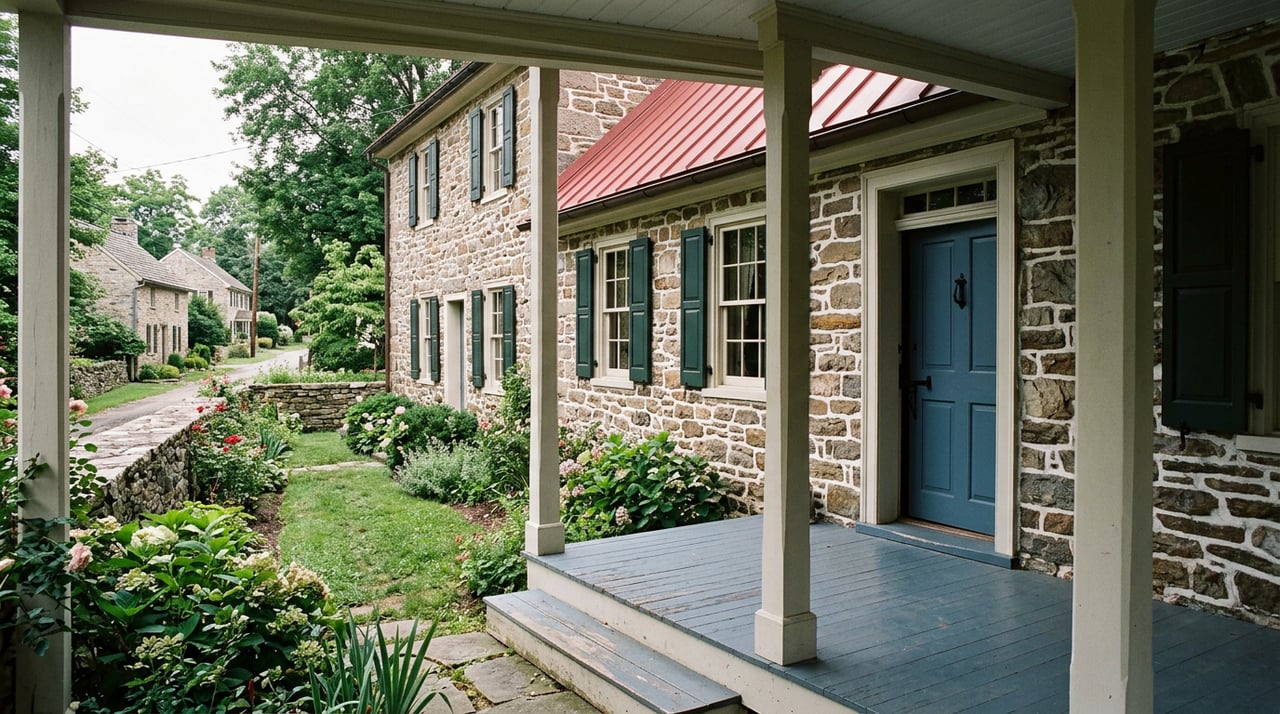
This is the part worth sitting with if you are comparing a specific Hillsboro property to a similar one two streets away. The postcard version of the town, a preserved 18th-century mill village with stone houses and hand-laid brick, is accurate. It is also not the whole picture for a house whose front door opens onto Charles Town Pike.
What This Means If You're Comparing Addresses
Hillsboro's National Register historic district was first listed in 1979 with 40 contributing buildings, and the boundary was enlarged in 2009 and 2010 to capture more of the town's original fabric. The town itself is tiny by any measure, with a population estimated at 108 residents in 2026, down slightly from 113 at the 2020 census. The Old Stone School and its surrounding parcels only came inside official town limits in a 2016 zoning change that tripled the corporate boundary to 172 acres.
Put those two facts together, a historic district this small and a population this thin, and you get a housing market where sales are occasional events rather than a monthly rhythm. National listing sites reflect that volatility in a way that is easy to misread if you don't know why it happens. In February 2026, one widely used listing platform put Hillsboro's median sale price at $1.37 million. Another, tracking the three months ending in April 2026, put the trailing median at $670,000. That is not two different markets. It is the same tiny market, sampled at two different moments, with each individual sale swinging the median because there are so few sales to average.
That volatility is exactly why frontage matters more here than in a larger town. A property directly on Charles Town Pike carries the daily reality of the corridor: the estimated 17,000 vehicle trips, the freight that still hasn't been fully rerouted, the proximity to a road the town itself has said is carrying weight it was never designed for. A property on one of the lanes off the pike, or out past the town's historic core toward the surrounding farmland and orchards, is a genuinely different proposition even if both show up under the same "Hillsboro" heading online.
Questions Worth Asking Before You Write an Offer
- Does the property front Charles Town Pike directly, or sit on a side lane or access road off it
- Has the town or VDOT published any update on the truck task force's progress since it was formed
- What is the property's actual distance from the roundabouts at either end of town, where truck deceleration and acceleration noise is heaviest
- Is the home inside the expanded 2009 historic district boundary, and if so, what documentation exists on any exterior work done since
- How many comparable sales has the specific block seen in the past two to three years, given how few transactions the whole town generates in a typical year
None of this is a reason to avoid Hillsboro. It is a reason to ask sharper questions than the listing photos will answer. A stone house on Charles Town Pike and a stone house three hundred yards off it can carry very different daily experiences even when they share a ZIP code, a historic district designation, and an asking price in the same range.
The Bigger Picture
Hillsboro's leadership did something genuinely difficult: they took on a $30 million infrastructure project in a town of roughly 100 people, finished it ahead of schedule and on budget, and preserved the historic character of a 269-year-old village while modernizing its water, sewer, and utilities from the ground up. That is not a small accomplishment, and it is why the village remains one of the most distinctive addresses in Western Loudoun. The freight question is simply the next chapter the town is still writing, with VDOT and county officials at the table, and it is one worth understanding before you decide exactly where on the map you want to stand.
If you are comparing a Hillsboro property to other Western Loudoun villages and want a clearer read on how a specific address sits relative to the Route 9 corridor, Carter Braxton Preferred Properties can walk the parcel with you and help you ask the right questions before you write an offer. Request a confidential home valuation and consultation to start the conversation.


